
Per-Outlet Pricing
Introduction
A product rarely carries the same price everywhere. An airport kiosk charges more than a high-street shop, a staff canteen charges less, and an outlet running a local promotion needs its own figure without touching the online store.
Per-Outlet Pricing lets each outlet hold its own selling price for a product or variation. When a price is set, the register shows it, charges it, and records it on the order. When it is left empty, nothing changes — the outlet sells at the WooCommerce price, exactly as before.
Setting an Outlet Price
Outlet prices are set in the Price column of the Bulk Assignment sheet, under the outlet you want to price.
Navigation path:WooCommerce Point of Sale → Outlets → Bulk Assignment
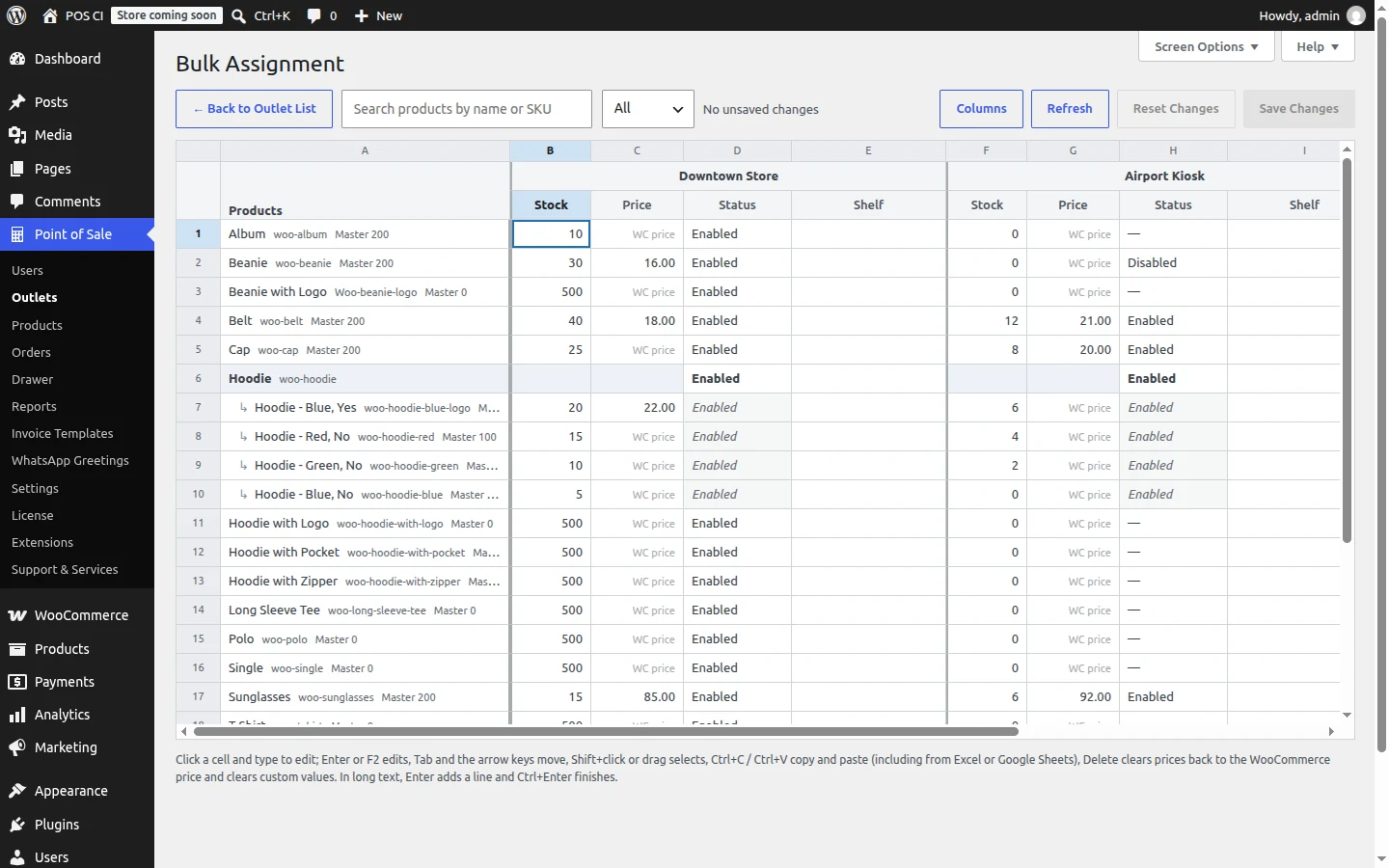
- Find the product, or a variation of a variable product.
- Click the Price cell under the outlet you are pricing.
- Type the price and press Enter.
- Click Save Changes.
A cell showing WC price has no outlet price: that outlet sells at the WooCommerce price. To go back to that, select the cell and press Delete.
Prices belong to variations
On a variable product, the price is set on each variation, not on the parent row. The parent row's Price cell is blank and read-only.
How the Price Is Applied
When an outlet price is set, it is the selling price at that outlet. The register shows a single price with no strike-through and no On Sale badge, and any WooCommerce sale price is ignored at that outlet.
The register works through these in order and uses the first one it finds:
| Priority | Price |
|---|---|
| 1 | A multi-price row chosen by the cashier |
| 2 | The outlet price |
| 3 | The WooCommerce sale price |
| 4 | The WooCommerce regular price |
A cashier who is allowed to edit prices in the cart is still capped at the resulting price, exactly as before.
Tax
An outlet price is entered in the same tax mode as the WooCommerce price field — inclusive or exclusive of tax according to your WooCommerce tax settings. Tax is then calculated from the outlet price, so the register and the order stay consistent with the rest of the store.
On the Order
The order records what the outlet actually charges. When a cashier edits a price in the cart, the difference is still recorded as a per-product discount, as it is today.
Because registers cache product data, a register that has not reloaded since a price change may still show the old price. The order is protected either way:
- If the cached price was lower than the current outlet price, the order records the outlet price and the shortfall becomes a discount.
- If the cached price was higher, the order records what was actually collected at the till, never less.
Reaching the Registers
Saving a price updates a store-wide price marker. The next time a register loads, it notices the change and refreshes its cached products automatically — no manual resync is needed. Registers already open keep their cached prices until they are reloaded or resynced.
Notes and Limits
- A price of 0 is rejected while Enable zero price products is disabled in POS settings, because a zero price hides the product at the register.
- Multi-pricing rows do not have per-outlet prices.
- Weight-priced items keep their weight-based calculation.
- Prices are per outlet and per product or variation; there is no per-user pricing.
Related Features
- Bulk Assignment — the sheet where outlet prices are set.
- Checkout Discounts & Coupons — discounts and coupons applied on top of the selling price.
- Products & Inventory — master stock and product setup.